









 English
  Français
  Español


Content
- 1 What Is Deck Joist Spacing and Why Does It Matter?
- 2 Standard Joist Spacing by Decking Material
- 3 How to Calculate the Number of Joists You Need
- 4 Joist Spacing for Different Deck Board Patterns
- 5 Blocking: When, Where, and How to Install
- 6 Joist Spacing for Commercial & High-Load Applications
- 7 Common Mistakes in Deck Joist Spacing (and How to Avoid Them)
What Is Deck Joist Spacing and Why Does It Matter?
Deck joist spacing is the distance between the centers of two adjacent horizontal framing members—the joists—that support the deck boards. Measured “on center” (OC), this dimension controls how much weight the floor can carry, how it feels underfoot, and how the surface looks over time. A deck framed at 16 inches OC feels solid and meets most residential codes. A deck pushed to 24 inches OC might save lumber but often introduces visible deflection and a hollow bounce.
Getting the spacing right from the start prevents a cascade of problems. Joists placed too far apart cause deck boards to sag, fasteners to loosen, and the entire structure to weaken years ahead of schedule. Too many joists, on the other hand, waste material and add labor without real benefit. The sweet spot depends on three things: the deck board material, the joist lumber size and species, and the loads the deck will carry.
A subtle point many DIY guides skip is the difference between on-center spacing and clear span. With 16-inch OC spacing and standard 1.5-inch-wide joists, the actual gap between joist edges is only 14.5 inches. That narrower clear span is what directly supports the deck board. When you switch to a thinner composite profile or a hardwood species that resists bending poorly, every half inch matters.
Standard Joist Spacing by Decking Material
Not all deck boards can handle the same joist layout. Traditional 5/4 pressure-treated wood decking often performs well at 16 inches OC, but many lightweight composites and tropical hardwoods demand tighter spacing. The table below summarizes manufacturer-recommended maximums for four common material categories, assuming perpendicular installation and standard residential loading of 40 psf live load.
| Decking Material | Max Joist Spacing (OC) | Typical Maximum Span (2x8 joists) | Key Considerations |
|---|---|---|---|
| Pressure-treated pine (5/4 x 6) | 16" | 11 ft 10 in | Allowed up to 24" for some 2x6 decking, but feel may suffer. |
| Tropical hardwood (ipe, cumaru) | 12"–16" | 12 ft 6 in | Dense and stiff; 12" spacing recommended for grain stability. |
| Standard WPC composite | 12"–16" | 9 ft 11 in | Often requires 12" OC in hot climates or for diagonal patterns. |
| Co-extrusion WPC / capped composite | 16" | 10 ft 6 in | Higher rigidity than older composites; verify manufacturer's span table. |
| Aluminum co-extrusion decking | 16"–24" | 14 ft 0 in | Structural aluminum core permits wider spacing and longer spans. |
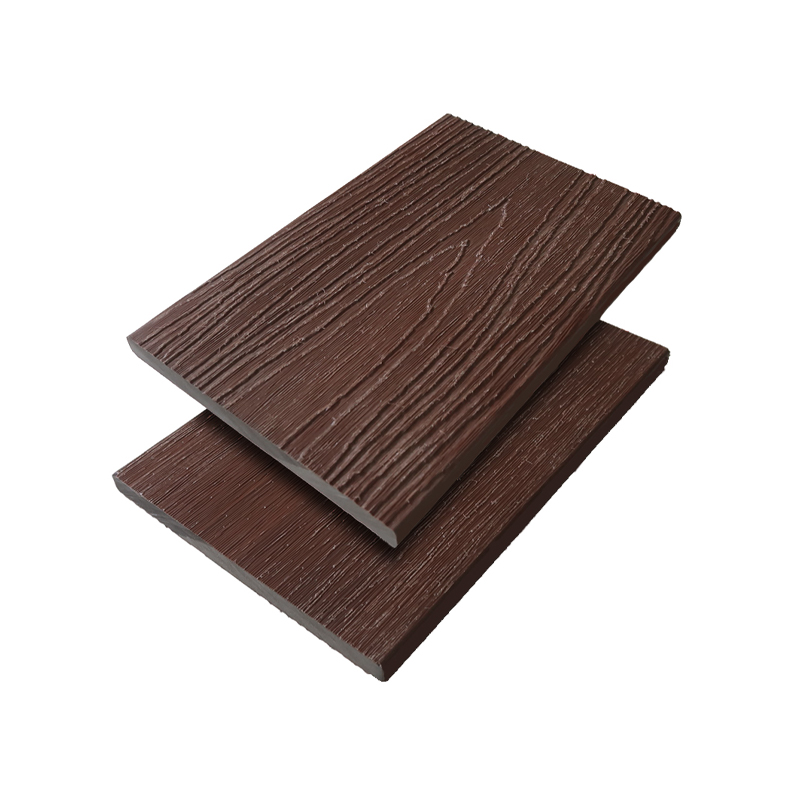
Co-extrusion WPC products such as those using an outer polymer shell around a wood-plastic core can reliably support 16-inch OC framing, even in full sun. Products like co-extrusion WPC decking add a second protective layer that reduces thermal expansion, so the board stays flatter across wider joist bays. When you step up to an aluminum-core composite like aluminum co-extrusion decking, 24-inch OC spacing becomes possible without noticeable deflection—this can cut your framing lumber by nearly one-third compared with a 16-inch OC layout on the same footprint.
Always cross-reference the joist spacing printed on the board wrapper with your local building code. Even if a manufacturer allows 24 inches OC, many municipalities cap residential decks at 16 inches OC regardless of the decking installed. The International Residential Code (IRC) table R507.5 provides maximum joist spans based on species, grade, and spacing; use it as your baseline before adjusting for specialty deck boards.
How to Calculate the Number of Joists You Need
The math is straightforward: divide the total deck length (in inches) by the on-center spacing, round up, and add one. For a 10-foot-long deck, a 12-inch OC layout gives 11 joists, 16-inch OC gives 9 joists (rounded up from 7.5 +1), and 24-inch OC yields 7 joists. That difference of four joists on a modest deck translates to real money and faster framing.
Consider a 10 x 12-foot deck framed with southern pine 2x8 joists priced at $14 each. At 12 inches OC you need 13 joists (for the 12-foot dimension), 16 inches OC requires 10 joists, and 24 inches OC only 7 joists. The lumber cost alone drops from about $182 to $98 by moving from 12 to 24 inches OC. But cutting joist count must not compromise safety or board warranties. A $84 saving today can cost $2,000 in rotted, sagging boards five years from now.
| Joist Spacing (OC) | Number of Joists (12 ft span) | Joist Lumber Cost | Notes |
|---|---|---|---|
| 12" | 13 | $182 | Required for some composites and in high-humidity zones. |
| 16" | 10 | $140 | Standard for wood and co-extrusion composites. |
| 24" | 7 | $98 | Allowed only with certain aluminum-core or 2x6 rigid decking. |
Always add one end joist to your count and verify that the outermost joists sit flush with the deck’s rim. For double picture-frame borders or stairs, you will need extra blocking and rim joists that aren’t included in this raw joist tally, so budget additional lumber accordingly.
Joist Spacing for Different Deck Board Patterns
A standard perpendicular deck layout works with the manufacturer’s stated maximum spacing. But diagonal, herringbone, or picture-frame designs introduce angles and seam locations that demand extra support. When boards run at 45 degrees to the joists, the distance between supports along the board is effectively longer—about 1.4 times the joist spacing. What works at 16 inches OC perpendicular can feel spongy on the diagonal.
For diagonal installations, drop the spacing by one increment. If the manufacturer calls for 16 inches OC, frame at 12 inches OC for a diagonal deck. The same logic applies to herringbone and chevron patterns: the zigzag layout creates frequent board ends that follow no single joist line, so a tighter grid prevents unsupported edges. Picture-frame borders around the deck perimeter need blocking between the outside rim joist and the first field joist to catch the border board’s inside edge.
Blocking becomes critical when board seams land between joists. In a diagonal pattern, every cut board end that doesn’t hit a joist must rest on a solid block installed between the adjacent joists. For large decks, this can add dozens of short blocking pieces. Using a 12-inch OC layout reduces the number of floating seams and often eliminates the need for mid-span blocking in the field of the deck, saving installation hours.
Blocking: When, Where, and How to Install
Blocking is the short length of joist material installed perpendicular between two parallel joists. Its main job is resisting lateral twisting and keeping joists uniformly spaced under load. Without blocking, even properly sized joists can rotate, pulling fasteners loose and creating noisy, uneven deck surfaces. Think of blocking as a brace that turns a row of individual joists into a single stiff grillage.
IRC guidelines and common practice dictate blocking at mid-span for joists spanning more than 8 feet. For a 12-foot joist span, place one row of blocking at the 6-foot mark. Composite decking manufacturers often go further: they recommend blocking every 4 to 6 feet on center, and always at butt joints where two deck boards meet. When you install a picture-frame border or transition from a horizontal to a diagonal board, every change in direction needs solid blocking beneath it.
| Joist Span | Row of Blocking Required | Additional Blocking Locations |
|---|---|---|
| Up to 8 ft | Not required by IRC (verify manufacturer) | At all board butt joints and perimeter borders |
| 8 ft – 12 ft | One row at mid-span | At board seams and at stairway landings |
| 12 ft – 16 ft | Rows at 1/3 and 2/3 span points | Any point where deck board pattern changes |
Use the same dimension lumber for blocking as the joists and fasten with structural screws or 16d nails in a staggered pattern. Toe-nailing alone is not sufficient for composite-deck blocking; metal connectors or screws driven through the joist into the blocking create a much stronger connection. Always install joist tape over the top of blocking and joists to keep water from pooling on the horizontal surfaces.
Joist Spacing for Commercial & High-Load Applications
Residential decks are designed for a 40 pounds-per-square-foot live load. Rooftop terraces, public walkways, and commercial restaurant decks often must carry 60 to 100 psf. That extra demand shrinks allowable joist spans and pushes spacing requirements toward 12 inches OC or even tighter. A 2x8 southern pine joist that spans 10 feet 6 inches at 16 inches OC under residential loading may only cover 8 feet 6 inches under a 60 psf commercial load.
Waterfront and poolside decks add a moisture factor. Wood and standard composites absorb moisture and lose stiffness, so a 12-inch OC layout gives a safety margin against swelling-induced buckling. Here, materials with high inherent rigidity thrive. Aluminum co-extrusion deck boards maintain their span rating even in saturated conditions because the aluminum core does not swell, rot, or soften. This allows designers to push spacing to 16 inches OC in commercial settings without risking field deflection or code rejection.
When engineering for high loads, also shorten blocking spacing to every 4 feet and double up rim joists to handle concentrated edge loads from planters, hot tubs, or crowd barriers. A structural engineer should always review rooftop or raised terrace plans, but starting with a 12-inch OC grid ensures that the framing easily meets the preliminary load calculations and leaves room for future upgrades.
Common Mistakes in Deck Joist Spacing (and How to Avoid Them)
Most spacing failures happen before the first nail is driven. Relying on a single “rule of thumb” for all materials, skipping the span table, and assuming the old deck’s layout was correct lead to chronic underbuilding. The five pitfalls below show up on job sites repeatedly—and each has a straightforward fix.
- Mistake: Using 24-inch OC spacing for composite decking because “the store display looked fine.” Fix: Read the printed installation instructions. Most capped composites require 16-inch OC max; some limit to 12-inch OC for commercial or diagonal installations.
- Mistake: Ignoring cantilever limits. The IRC allows a joist overhang of up to one-quarter of the joist span, but many carpenters let joists run past the beam by 3 feet or more. Fix: Use the beam as the pivot point and keep the overhang below 25% of the backspan, or add a second beam.
- Mistake: Not adjusting spacing for deck board direction. Fix: If boards run at 45 degrees, shrink spacing by one step (24 down to 16, 16 down to 12).
- Mistake: Omitting blocking at the mid-span or seams. Fix: Install blocking at the span’s centerline for joists over 8 feet, and place blocks under every board butt joint.
- Mistake: Assuming all 2x8 lumber has the same strength. Fix: Check the grade stamp. Southern pine #2 spans farther than spruce-pine-fir #2; a span table tells you exactly how far you can push a given species and spacing.
These errors compound silently. A deck can feel solid after construction but develop creaks and sags after two seasonal cycles. Avoid them by creating a written framing plan that notes joist spacing, blocking rows, and every cantilevered edge before cutting any lumber.