











 English
  Français
  Español


Content
- 1 The Short Answer: Salt and Composite Decking
- 2 Why Rock Salt Is Risky for Composite Decking
- 3 How Wood Fiber Content Affects Salt Sensitivity
- 4 Safe De-Icing Options for Your Composite Deck
- 5 Step-by-Step Guide to Removing Ice Safely
- 6 Protecting Pets, Plants, and Your Deck Warranty
- 7 Post-Winter Deck Cleaning and Maintenance
Winter arrives, ice forms on your composite deck, and the instinct is to grab the nearest bag of rock salt. Before you do, it's worth understanding how salt interacts with composite and WPC (Wood Plastic Composite) materials — because the wrong choice can quietly shorten the life of your deck. The straightforward answer: rock salt is not recommended for composite decking, but calcium chloride-based ice melt can be used safely when applied correctly.
The Short Answer: Salt and Composite Decking
Composite decking is engineered to resist rot, moisture, insects, and warping — but that durability has limits when chemical de-icers enter the picture. Rock salt (sodium chloride) is the most commonly used ice-removal product, yet most composite decking manufacturers either advise against it or explicitly exclude it from their warranty coverage.
The good news is that you are not without options. Calcium chloride and magnesium chloride ice melts are gentler on composite surfaces and effective at lower temperatures than plain rock salt. Used carefully and cleaned up promptly, they let you keep your deck safe in icy conditions without sacrificing its appearance or structural integrity.
Why Rock Salt Is Risky for Composite Decking
Sodium chloride works by dissolving into moisture and lowering the freezing point of water. That chemical process is effective on ice — but it does not stop when the ice is gone. Left on a composite surface, rock salt continues to interact with the decking material in ways that accumulate over multiple winters.
The three main concerns are:
- White residue and surface dulling. Salt crystals left on the board surface dry into a chalky film that detracts from the deck's appearance. On textured or dark-colored boards, this residue is especially visible and can be difficult to remove completely.
- Accelerated fading and surface breakdown. Repeated salt exposure can degrade UV-protective coatings on composite boards. Over time, this leads to uneven fading, a rougher texture, and boards that look older than they are.
- Moisture absorption and board movement. Salt draws moisture from the surrounding air and encourages it to wick into the board material. Repeated cycles of moisture absorption and drying cause swelling, minor warping, and — on lower-quality composites — cracking along the board edges.
Beyond aesthetics, using rock salt may void your manufacturer's warranty. Many brands explicitly state that sodium chloride is not an approved maintenance product. If damage appears after winters of salting, warranty claims can be denied.
How Wood Fiber Content Affects Salt Sensitivity
Not all composite decking responds to salt the same way, and understanding why starts with the material composition. WPC boards are made from a blend of wood fibers and thermoplastic polymers such as HDPE (high-density polyethylene), PP (polypropylene), or PVC. The ratio between these two components has a direct effect on how vulnerable the board is to chemical de-icers.
Boards with a higher wood fiber content — commonly 70% or more — are more porous by nature. The wood component absorbs moisture more readily, which means salt-driven moisture wicking causes faster and more pronounced damage. Boards with a lower wood fiber content and a higher plastic polymer ratio are considerably more resistant, as the thermoplastic component forms a denser barrier against moisture and chemical penetration.
WPC composite decking boards that use a capped construction add a further layer of protection: a co-extruded polymer shell permanently bonded to the board's core. This capping layer significantly reduces moisture ingress and chemical interaction at the surface, making capped boards the most resilient option for climates where ice removal is a seasonal necessity. Co-extrusion WPC decking is specifically engineered for this kind of long-term weather resistance, and it is the format that holds up best when de-icing products are used over multiple winters.
If you are unsure about your board's composition, check the manufacturer's technical data sheet. The wood fiber percentage and whether the board is capped or uncapped will tell you a great deal about its salt tolerance.
Safe De-Icing Options for Your Composite Deck
Choosing the right de-icing product is the single most important decision you can make for your deck's winter health. The two recommended options are calcium chloride and magnesium chloride.
| Product | Composite Safety | Effective Temperature | Pet Friendliness | Notes |
|---|---|---|---|---|
| Calcium Chloride | Good | Down to -25°F (-32°C) | Moderate — rinse paws | Best performance in extreme cold; may leave light residue |
| Magnesium Chloride | Good | Down to 0°F (-18°C) | Better than calcium chloride | Common in "pet-safe" formulas; gentler on surrounding landscaping |
| Rock Salt (Sodium Chloride) | Poor | Down to 20°F (-7°C) | Irritating to paws | Not recommended; may void warranty |
| Sand | Poor | No melting effect | Safe | Abrasive grit scratches composite surfaces over time |
| Dyed/Colored Ice Melt | Poor | Varies | Varies | Dye pigments can permanently stain textured board surfaces |
When purchasing a calcium or magnesium chloride product, look for labels that say "safe for concrete," "safe for flagstone," or "will not kill grass." These phrases indicate a formulation gentle enough for hardscape surfaces. Avoid any product with added colorants, as the dye can lodge in the grain texture of composite boards and be extremely difficult to remove.
Step-by-Step Guide to Removing Ice Safely
The method of application matters as much as the product itself. Follow these steps to protect your composite deck while keeping it safe underfoot.
- Clear loose snow first. Use a soft-bristle broom or plastic shovel to remove as much snow as possible before applying any de-icer. This reduces the amount of product needed and allows it to work directly on the ice. Never use a metal shovel, ice scraper, or snow blower, as these can permanently score the board surface. When shoveling, work parallel to the board direction rather than across it.
- Apply ice melt sparingly and evenly. Spread granules with a gloved hand or a plastic spreader. Apply only as much as needed to cover the icy surface in a thin, even layer. Piling on extra product does not speed up melting — it just increases residue and cleanup.
- Allow the product to work. Chloride-based ice melts act quickly. Give the product time to dissolve and create the brine solution that breaks down the ice layer.
- Remove slush and remaining granules promptly. Once the ice has loosened, sweep or push the resulting slush off the deck. Do not allow it to refreeze, as a second melt cycle doubles the chemical exposure. Sweep away any undissolved granules before they dry into residue.
- Rinse when conditions allow. As soon as temperatures rise above freezing, rinse the deck surface with a garden hose to clear any remaining chemical traces. If using a pressure washer, keep the pressure below 1,500 psi and hold the nozzle at least 12 inches from the surface.
Protecting Pets, Plants, and Your Deck Warranty
Even the gentler de-icing products carry considerations beyond the deck itself.
For pets: Keep animals off the deck until granules have been swept and the surface has been rinsed. Ice melt residue on paw pads causes irritation. If a pet does walk through treated areas, wipe their paws thoroughly before they go indoors. Products marketed as "pet-safe" — typically magnesium chloride formulas — reduce but do not eliminate this risk, so the same caution applies.
For plants and landscaping: Avoid over-applying ice melt near garden beds or lawn edges. Runoff containing chloride compounds can affect soil composition and damage sensitive plants over repeated seasons. Apply only to the walking surface and sweep excess away from deck edges before rinsing.
For your warranty: Before using any de-icing product, review the care guidelines provided by your decking manufacturer. Many brands explicitly list approved and prohibited substances. Using an unapproved product — even once — can create grounds for a warranty claim to be denied if surface damage is later discovered. When in doubt, contact the manufacturer directly to confirm which products are acceptable for your specific board line.
Post-Winter Deck Cleaning and Maintenance
When the cold season ends, a thorough cleaning removes any chemical accumulation and sets your deck up for a full year of good performance.
Start by sweeping the entire surface to remove debris, dried granules, and any organic matter that has accumulated over winter. Follow with a wash using mild soap and water, scrubbing with a soft-bristle brush. Work in the direction of the board grain to avoid scratching the surface texture. Rinse thoroughly and allow the deck to dry completely before placing furniture or rugs back.
If any salt residue or staining remains after washing, a diluted solution of white vinegar and water can help neutralize salt deposits. For more stubborn marks, a composite deck cleaner formulated for your board type is the safest option. Avoid bleach-based cleaners on colored boards, as they can cause uneven fading.
This is also a good time to inspect the board surface for any signs of scratching, fading, or edge deterioration that may have developed over winter. Early detection allows you to address minor issues before they worsen through a summer of heat and UV exposure.
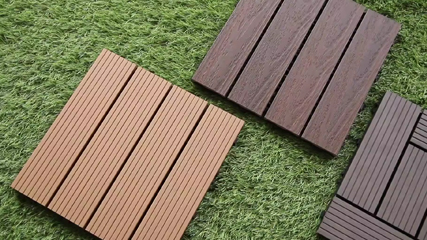
For outdoor spaces where ice is a recurring challenge, consider adding temporary outdoor runners or rubber-backed mats to high-traffic areas during winter months. These reduce the need for de-icing products altogether while providing reliable traction. WPC decking tiles with built-in slip resistance are another long-term solution worth considering for balconies, entryways, or areas that tend to collect standing water.
With the right products, careful application, and consistent cleanup, your composite deck can handle many winters and come out looking as good as the day it was installed.